Everyday Life & Shared Experiences
Living with ME/CFS and explaining it to others

Living Alongside ME/CFS- Relatable Sayings and Shared Experiences
Understanding Energy
My energy is limited, but my value is not."
"Pacing is not giving up, it's moving forward sustainably."
"Every day requires choices about where my energy goes."
"Living within my energy envelope helps me maintain stability."
"What looks like rest is often essential treatment."
Invisible Illness
“Just because you can't see it, doesn't mean I'm not living with it."
"ME/CFS is invisible, but its impact is real."
"Looking well doesn't mean feeling well."
"An invisible illness still deserves visible understanding."
"My symptoms may be hidden, but they are never absent."
Strength and Resilience
Strength isn't always pushing through; sometimes it's stopping."
"Resilience can look like resting when your body demands it."
"Small victories are still victories."
"I adapt every day to challenges others never see."
Post- Exertional Malaise (PEM)
"With ME/CFS, activity today can affect tomorrow."
"Activity in not limited to physical tasks. Any form of exertion can impact symptoms, including physical movement, thinking and concentration, emotional stress, and social interaction"
"Recovery is not measured in minutes or hours."
"The consequences of exertion are often delayed."
"Listening to my body is a necessity, not a choice."
"Respecting limits helps protect function."
Self-Compassion
"My worth is not measured by productivity."
"Rest is not laziness."
"I am more than my illness."
"It's okay to do less when my body requires it."
"Being kind to myself is part of managing ME/CFS."
Patient Voices
"My life is not measured by what I can do in a day, but by how carefully I balance my energy."
"Some days I participate in life. Other days I recover from participating."
"I spend more time managing energy than most people realise."
"My symptoms fluctuate, but the illness is always there."
Living with ME/CFS means navigating uncertainty, balancing activity with recovery, and adapting to changing levels of function. Every person's experience is unique, and there is no one-size-fits-all journey. Whatever your current level of functioning, your experiences are valid, and you deserve understanding, support, and respect
Trying to explain ME/CFS to others
Many people with ME/CFS describe feeling that they constantly have to explain or justify their symptoms because they do not fit traditional expectations of illness. Unlike a broken bone or visible injury, the effects of ME/CFS are often hidden from view.
The faulty battery analogy
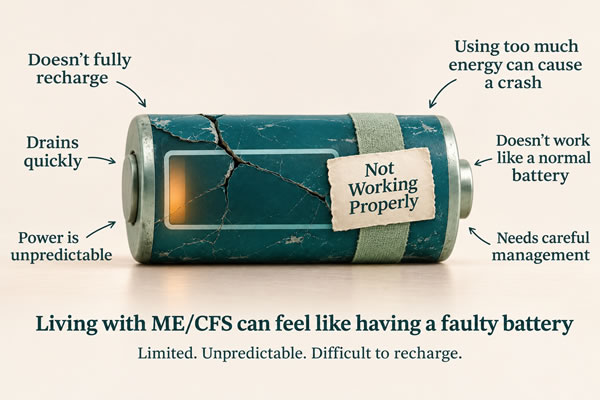
Many people find it helpful to describe ME/CFS using the analogy of a faulty battery.
"Living with ME/CFS can feel like starting each day with a battery that's only partially charged, never knowing exactly how much power is available or how quickly it will run out."
"Most people recharge overnight. People with ME/CFS often wake up feeling as tired as when they went to bed."
"It's not a low battery. It's a faulty battery that doesn't charge, hold, or use energy in the usual way."
This analogy helps explain why activities that may appear simple to others can come at a significant physical and cognitive cost for someone living with ME/CFS.
Importantly, activity is not just physical. It can also be:
- Cognitive
- Emotional
- Social
Even seemingly minor activities can require significant energy and may contribute to worsening symptoms.
When others can’t see the impact
The Invisible Nature of ME/CFS
Many illnesses have visible signs that help others understand the difficulties a person may be experiencing. ME/CFS is often different because there may be no obvious outward signs of illness despite substantial limitations and symptoms.
Although the impact on daily life can be profound, there are often no obvious external signs of illness.
Many people with ME/CFS describe experiences such as:
"If I had a broken leg, you would see my limitations. Because I have ME/CFS, I often have to explain them."
"My illness is invisible, but its impact is visible in the things I can no longer do."
"People often see what I manage to do, not what it costs me to do it."
"The challenge isn't just living with ME/CFS. It's helping others understand it."
For many people, the illness is not only about managing symptoms. It is also about navigating misunderstanding, adjusting expectations, and repeatedly explaining an invisible condition that affects every aspect of life.
Perhaps the most important thing to understand is this:
ME/CFS may be invisible to others, but its effects are very real to those who live with it every day.
Spoon Theory
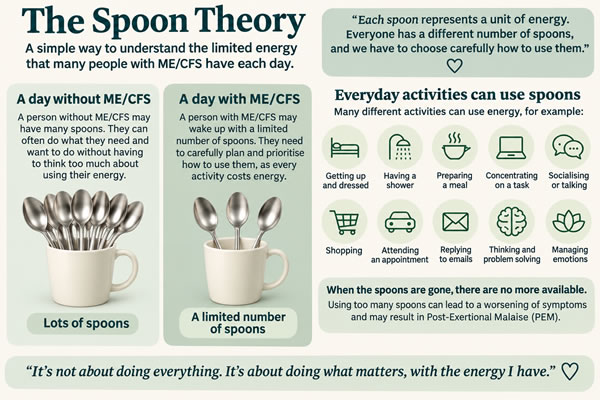
The Spoon Theory is a simple way of explaining the limited and unpredictable energy experienced by many people living with ME/CFS.
In Spoon Theory, each spoon represents a unit of energy available for the day.
A healthy person may be able to complete daily activities without having to think about how much energy they are using. By contrast, someone with ME/CFS often starts the day with a much smaller number of spoons and must carefully decide how they will be used.
Every activity requires energy, including:
- Getting washed and dressed
- Preparing meals
- Household tasks
- Working or studying
- Thinking and concentrating
- Socialising
- Attending appointments
- Managing emotions and stress
Once the available spoons have been used, there may be little or no energy left for other activities.
Using more energy than is available can result in Post-Exertional Malaise (PEM), the hallmark symptom of ME/CFS. Recovery may take hours, days, weeks, or sometimes longer.
The Difficult Choices
The Spoon Theory helps explain why many people with ME/CFS must make difficult choices every day.
"If I use my energy to attend a family event today, I may not have enough energy to prepare a meal tomorrow."
"Every decision involves weighing up what I can do against what it may cost me afterwards."
For many people with ME/CFS, managing energy is not about motivation or determination. It is about making constant decisions within the limitations of a restricted and unpredictable energy supply.
A Message for Family, Friends and Professionals
People living with ME/CFS are often doing far more than others realise.
The effort required to complete everyday activities, manage symptoms, plan recovery time, and avoid worsening health can be substantial.
When supporting someone with ME/CFS, one of the most valuable things you can offer is understanding.
Please remember: people living with ME/CFS are doing the best they can with the limited energy they have available.